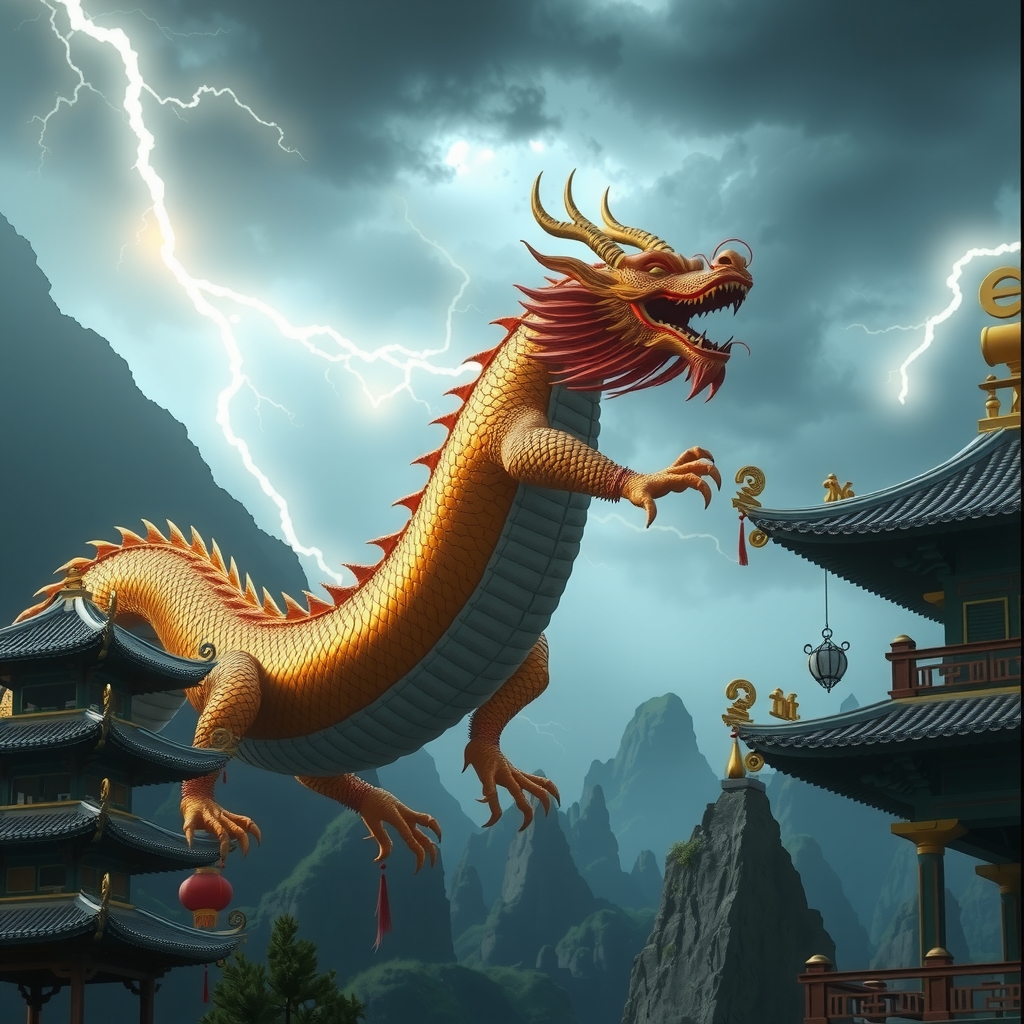
The Dragon Kingdom of Heaven
Where celestial dragons rule the skies, immortals walk among clouds, and the Jade Emperor presides over a cosmos born from a sleeping giant's dreaming body.
Begin the Journey ↓Pangu — The Creation of the World
Before the cosmos existed, the universe was a formless egg of primordial chaos — a swirling dark void called hundun. Within this cosmic egg slept Pangu, the first being, for eighteen thousand years. As he slumbered, yin and yang slowly separated within him.
When Pangu finally awoke, he found himself cramped within the egg and swung his enormous axe — or in some versions, simply pushed outward with all his might. The lighter, purer elements rose upward to form Heaven (yang); the heavier, denser elements sank to become Earth (yin).
Fearing that Heaven and Earth might merge again, Pangu stood between them, pushing upward with his hands and downward with his feet. Each day he grew three metres taller, and the separation grew with him. For another eighteen thousand years he held the heavens aloft until they were fixed in place.
Exhausted, Pangu collapsed and died — but in death he became the world itself. His breath became the winds and clouds; his voice became thunder; his eyes became the sun and moon. His four limbs and torso became the mountains and plains. His blood formed the rivers; his flesh the fertile soil; his hair the stars above.
The fleas and insects on Pangu's body became the first humans — a detail that later scholars found troubling and which was often quietly omitted, though it speaks to the raw mythic power of the original telling.
"From chaos comes all order; from one sleeping giant, all creation."
The Jade Emperor & the Celestial Court
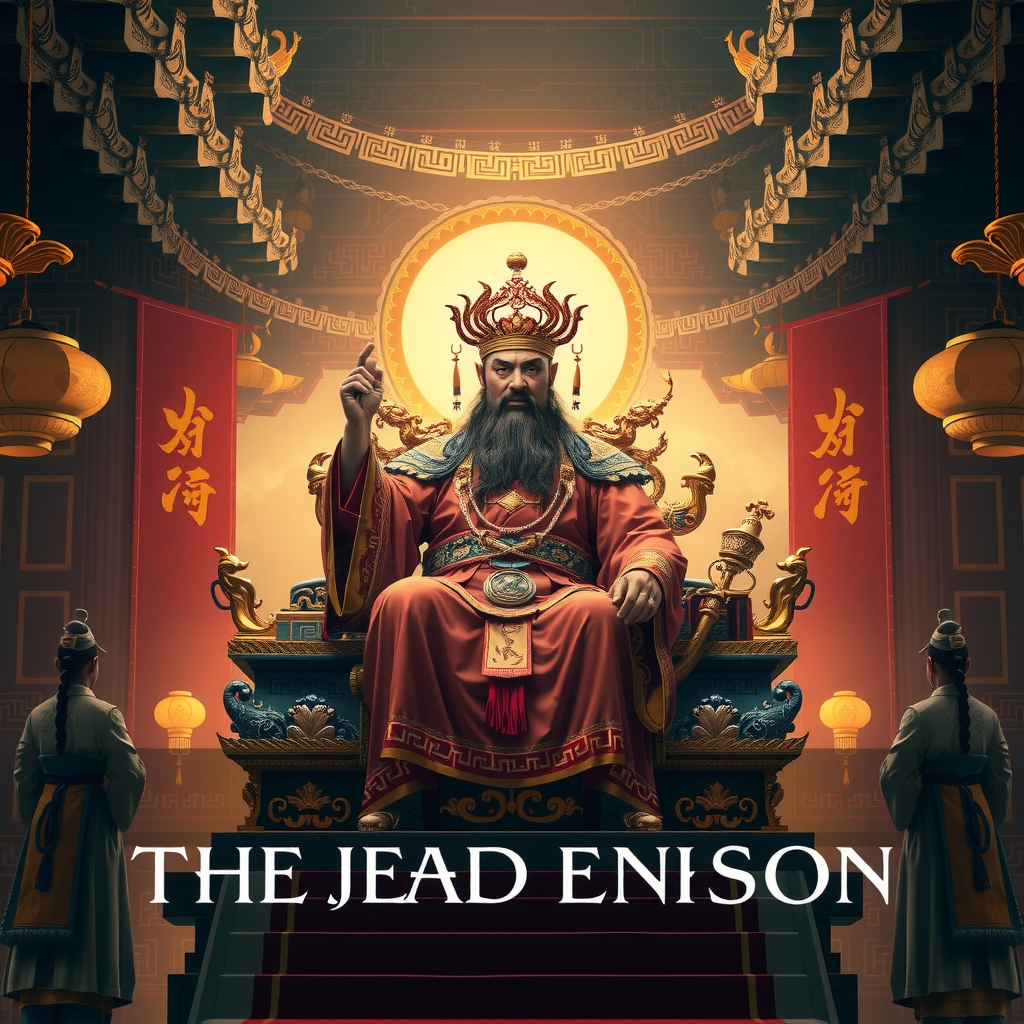
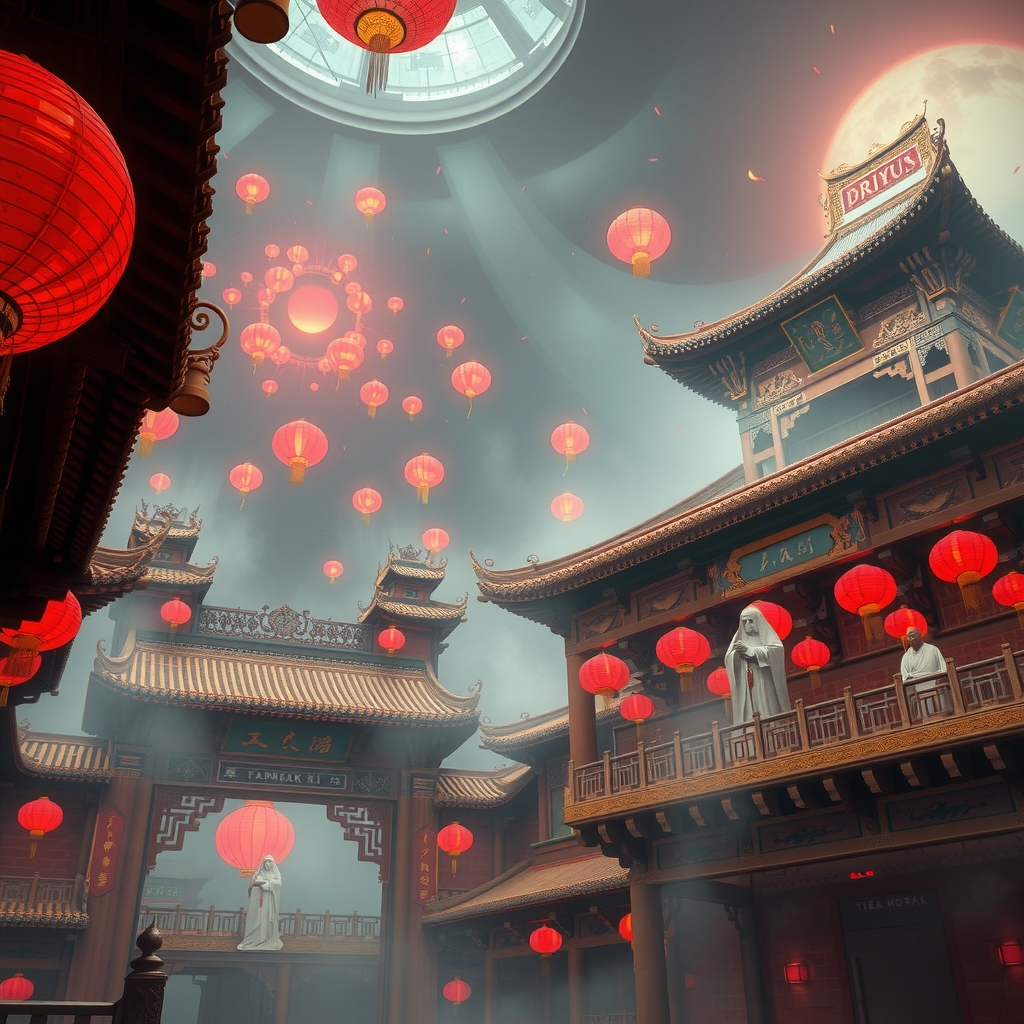
Above the mortal realm, beyond the thirty-three heavens, the Jade Emperor — Yù Huáng Dàdì — rules from his vast celestial palace. His is not a lonely sovereignty: the Heavenly Court is a vast divine bureaucracy mirroring the imperial structure of dynastic China, staffed by thousands of gods, ministers, generals, and celestial officials.
The Jade Emperor is said to have cultivated himself over vast aeons before ascending to divine kingship. He oversees the moral order of the universe, distributing punishments and rewards through an elaborate network of deities who report to him annually. Every New Year, the Kitchen God journeys to Heaven to deliver his report — so families traditionally burned the Kitchen God's portrait and smeared honey on his lips to ensure his report was sweet.
🌙 Chang'e — Lady of the Moon
The Moon Goddess who swallowed an immortality elixir and floated to the moon, where she lives in the Lunar Palace with her jade rabbit, eternally separated from her husband Hou Yi.
⚡ Lei Gong — God of Thunder
The drum-beating thunder deity depicted with eagle wings and claws, wielding a hammer to strike the wicked. His consort Dianmu illuminates the sky with mirrors of lightning.
🏮 Guanyin — Goddess of Mercy
The Bodhisattva of Compassion, among the most venerated figures in Chinese spiritual culture, who hears all prayers and descends to aid those in suffering.
⚔️ Nezha — The Lotus Prince
Born from a lotus flower, Nezha is a celestial warrior and trickster who famously returned his flesh to his parents and was reborn as a divine child riding wheels of wind and fire.
🌊 Dragon Kings (Sì Hǎi Lóng Wáng)
The four Dragon Kings rule the seas of the four cardinal directions, controlling rain and water, and are courtiers of the Jade Emperor despite their own vast dominion.
🔥 Zao Jun — Kitchen God
The domestic deity who observes every household and reports to Heaven yearly. Families offer him paper money and sweet foods before burning his image each lunar new year.
Sun Wukong — The Monkey King
I. Birth from Stone
On the mythic Mountain of Flowers and Fruit, a primordial boulder carved by wind and time absorbs the celestial essences of heaven and earth for millennia. One day it cracks open and from it leaps a stone monkey — already fully formed, eyes blazing with golden light that shoots skyward and alarms the Jade Emperor. This is Sun Wukong: born outside nature's normal order, beholden to no lineage, destined for something extraordinary.
The monkey quickly becomes king of the other monkeys on the mountain, leading them to a paradise of a waterfall-hidden cave. But immortality gnaws at him — he cannot accept that one day he will die — and so he sets out on a raft across the sea to find a teacher.
II. Apprenticeship & the Seventy-Two Transformations
After years of wandering, Sun Wukong finds the Taoist sage Patriarch Subodhi and becomes his student. Though the Patriarch nearly dismisses him repeatedly, the monkey's persistence wins him acceptance. Over many years, Sun Wukong masters the Seventy-Two Earthly Transformations (shapeshifting), cloud-somersaulting (travelling 108,000 li in a single leap), and countless other arts. When he begins showing off to fellow students, the Patriarch expels him — warning that his pride will bring catastrophe.
III. The Dragon Palace & the Magic Staff
Returning home, Sun Wukong finds his people threatened. He descends to the underwater Dragon Palace of the East Sea, demanding a worthy weapon. Dragon King Ao Guang shows him countless treasures, none sufficient. Finally, the Monkey King notices a great iron pillar glowing with divine light in the treasury's depths — the pillar once used by the Great Yu to measure the sea floor. When Sun Wukong approaches it, the pillar shrinks to a perfect staff. This is Ruyi Jingu Bang: 17,550 pounds of divine iron, capable of becoming as large as a pillar or as small as a sewing needle tucked behind his ear.
IV. Disruption of Heaven
Sun Wukong's ambition expands to match his power. He invades the Dragon Palaces of all four seas to acquire armor and weaponry, causing the Dragon Kings to report him to Heaven. When the Jade Emperor summons him, rather than punishing him, the celestial court attempts to tame him through titles — first a minor stable-keeper position, which the Monkey King accepts, only to be furious when he discovers its lowly status. He quits Heaven, declares himself "Great Sage Equal to Heaven," and defeats every celestial army sent against him. Even the mighty Erlang Shen cannot capture him definitively.
The Jade Emperor, running out of options, calls upon the Buddha himself.
V. The Buddha's Wager & Five Elements Mountain
The Buddha challenges Sun Wukong to escape from the palm of his hand. The Monkey King, supremely confident, leaps to what he believes are the pillars at the edge of the universe and carves his name there — only to discover upon returning that the pillar is merely one of the Buddha's fingers. He never left the palm. The Buddha closes his hand and traps Sun Wukong beneath Five Elements Mountain, where he remains imprisoned for five hundred years, sustained only by iron pellets and molten copper, waiting.
VI. Xuanzang & the Journey West
Five centuries pass. The monk Xuanzang (Tang Sanzang), chosen by Guanyin for a sacred mission, is travelling westward to retrieve Buddhist scriptures from India. He frees Sun Wukong, who agrees to serve as his protector — his pride finally tempered by imprisonment and submission. The headband that Guanyin places on the Monkey King tightens whenever Xuanzang recites a special sutra, keeping his violent impulses in check.
They are joined by Zhu Bajie (Pigsy), a former heavenly marshal reincarnated as a pig-man due to his lechery; and Sha Wujing (Sandy), a fallen river monster. Together the four pilgrims face eighty-one tribulations decreed by Heaven as necessary trials — a cosmic number, since nine times nine equals the Yang of completeness.
VII. Eighty-One Tribulations & Enlightenment
The journey encompasses some of Chinese literature's most magnificent episodes: the Flaming Mountain that can only be cooled by the Iron Fan Princess; the Spider Demon and Centipede Demon; the three encounters with the White Bone Demon whom Sun Wukong slays and is repeatedly punished for slaying; the Kingdom of Women where time and gender are inverted. Each obstacle tests different aspects of virtue — patience, discernment, loyalty, humility.
Upon reaching the Thunder Monastery in India and receiving the scriptures, the four pilgrims are apotheosized. Sun Wukong — the most transformed — becomes the Victorious Fighting Buddha, his egoic ambition finally resolved into genuine enlightenment. The journey that began with a stone monkey demanding to be equal to heaven ends with him ascending beyond it.
Nüwa & the Creation of Humanity
After Pangu's death shaped the landscape of the world, it was empty of conscious life. The serpent-bodied goddess Nüwa descended to walk upon the new earth — lonely, vast, and silent. She gazed into a still pool and saw her own reflection, and in that moment was moved to create beings like herself who could populate the beautiful world and fill it with voices.
Nüwa reached into the bank of the Yellow River and scooped up handfuls of golden clay. Working with divine artistry, she shaped the clay into small figures — arms, legs, faces, and the spark of life breathed into each. These became the first humans. She worked tirelessly, crafting each figure individually with her hands, and the first people she made this way were noble, gifted, and aristocratic.
As the task stretched on and the world was still largely empty, Nüwa devised a faster method. She dipped a reed into the clay and swung it, flicking droplets of mud across the landscape. Each droplet became a human being — these, the myths say, became the common people. This detail preserves an ancient social stratification within the myth itself: the carefully sculpted nobles and the mass-produced commoners.
But Nüwa's creative work did not end with humanity's birth. When the destructive water god Gonggong, enraged after his defeat in a battle with the fire god, headbutted the cosmic pillar Mount Buzhou and shattered it, the heavens tilted and the sky cracked. Floods poured through the fissures; fire raged across the earth; monsters crawled up from the deep. It was Nüwa who came forward to repair the world.
She gathered stones of five colours — black, white, red, yellow, and blue — and smelted them into a divine paste with which she patched the broken heavens. She then slew the great tortoise Ao and used its four legs as replacement pillars to hold up the sky. She gathered the reeds of the river and burned them into ash to dam the flood waters. The cosmos was restored — but forever tilted, which is why the sun, moon and stars all drift westward, and why China's great rivers all flow east toward the sea.
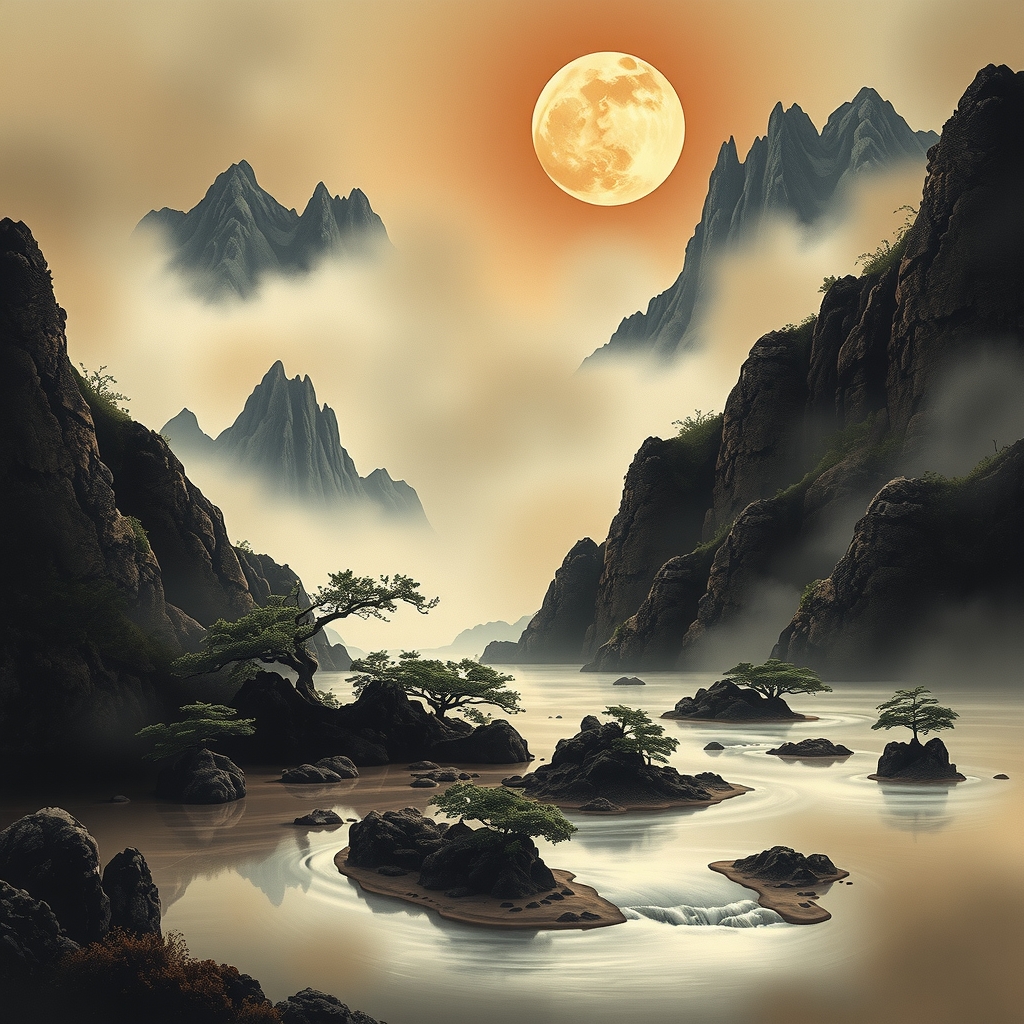
"In Chinese mythology, Nüwa is both a creator and a restorer — not merely an origin figure but an ongoing guardian of cosmic order, willing to act when the universe itself breaks apart."
Chang'e & the Moon
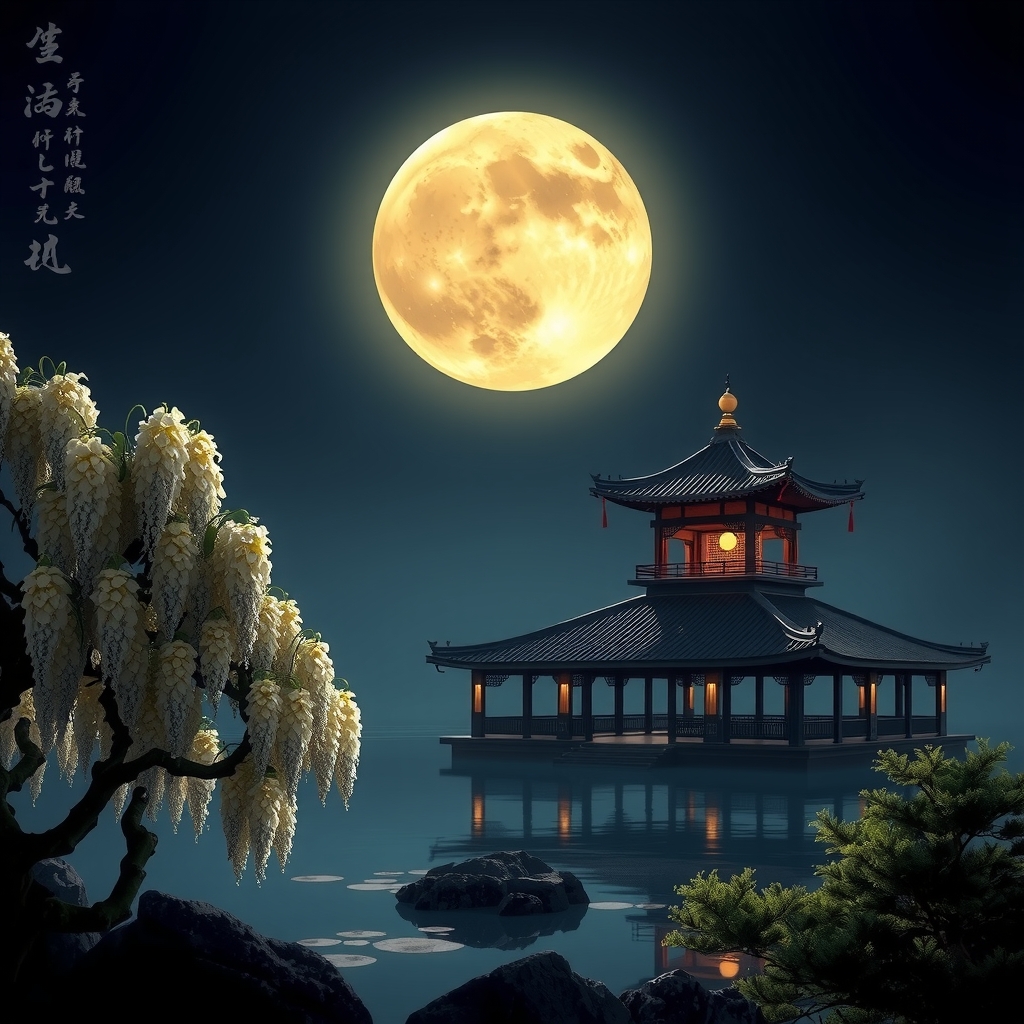
In the mythological age before recorded history, there were once ten suns — the ten children of the Eastern Emperor Di Jun — who took turns lighting the world, each day a different sun crossing the sky. One catastrophic day, all ten appeared together. The earth scorched; seas boiled; crops died; forests burst into flame. The people cried out and the Jade Emperor sent the divine archer Hou Yi to frighten the suns back into order.
Hou Yi, the greatest marksman in heaven or earth, took his red bow and white arrows and began to shoot. One by one the suns fell — burning birds tumbling from the sky. The Emperor, watching in horror as Hou Yi shot nine and prepared to loose a tenth arrow, quietly stole the last arrow from Hou Yi's quiver. One sun survived — the one that lights our world today.
For saving the earth, Hou Yi was celebrated as a hero. He married the beautiful Chang'e, and for a time they were supremely happy. But Hou Yi had been stripped of his divinity as punishment for the chaos of the shooting — he and Chang'e were now mortal. Desperate to spare his wife from death, Hou Yi journeyed to the Western Paradise to obtain the elixir of immortality from Xi Wangmu, the Queen Mother of the West. She gave him a single dose — enough for two to share a half-life of immortality, or one to ascend fully.
Hou Yi kept the elixir safely at home, awaiting an auspicious moment to share it with Chang'e. But different versions of the myth diverge here: in some, Chang'e drinks it to prevent Hou Yi's villainous apprentice Feng Meng from stealing it; in others, moved by an inexplicable celestial compulsion, she drinks it alone. The elixir fills her body with such lightness that she floats upward through the ceiling, through the clouds, rising irresistibly toward the moon.
On the moon, Chang'e found herself alone in the cold Lunar Palace — the Guanghan Gong, the Palace of Vast Cold. Her only companions are the jade rabbit who endlessly pounds immortality medicines with a mortar and pestle, and the woodcutter Wu Gang who is condemned to chop at an ever-regenerating osmanthus tree for eternity. Hou Yi, left on earth, could only gaze at the moon on clear nights and burn offerings to the wife he could never reach.
This myth of beautiful, painful separation gave rise to the Mid-Autumn Festival — held on the fifteenth day of the eighth lunar month when the moon is fullest and brightest. Families gather to eat mooncakes, carry lanterns, and gaze at the moon together, honoring both the goddess within it and the human longing for reunion across impossible distances.
The Dragon Kings of the Four Seas
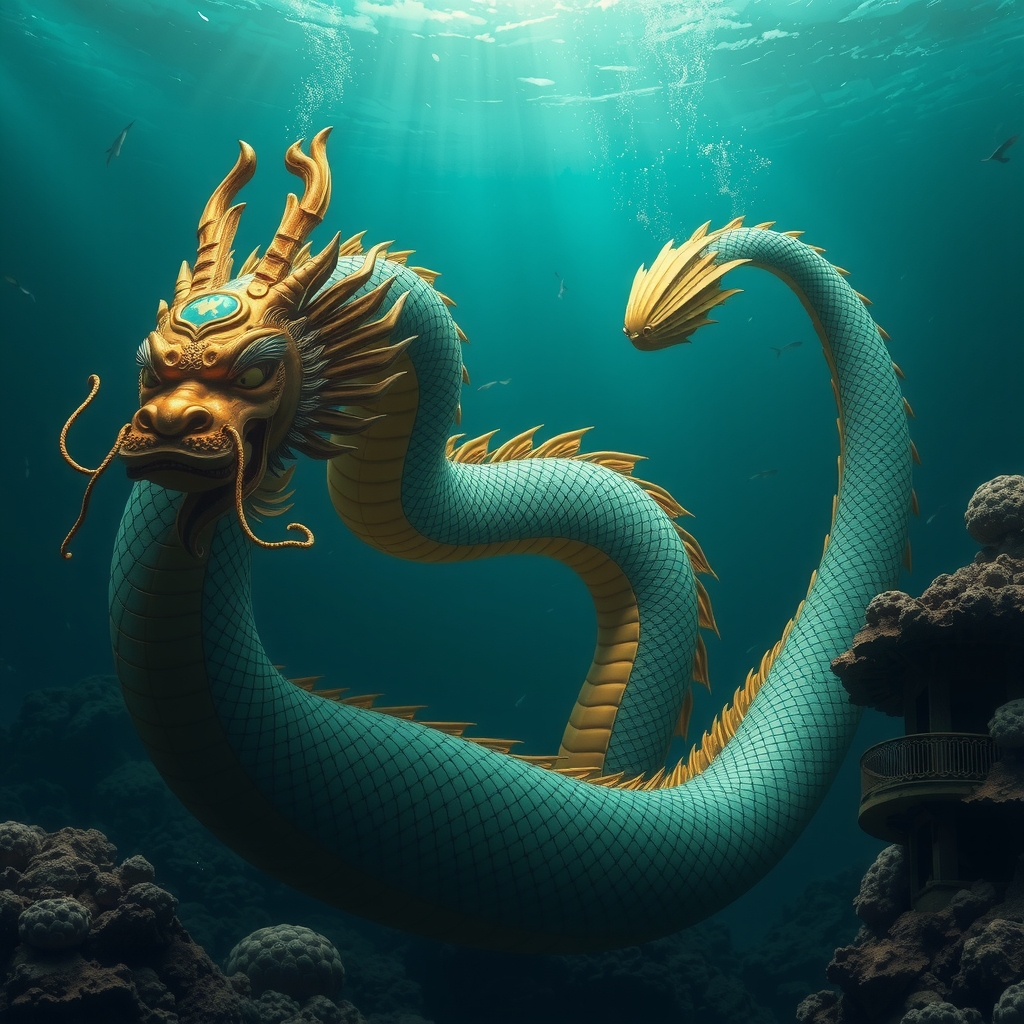
While all dragons command reverence in Chinese mythology, the Dragon Kings — Sì Hǎi Lóng Wáng, the Four Sea Dragon Kings — stand apart as sovereign rulers of the world's waters. Each governs one of the four cardinal seas and commands vast underwater palace-kingdoms populated by sea creatures, divine fish generals, and crab courtiers.
🔵 Ao Guang
Dragon King of the East Sea — the most senior and powerful, ruler of the Eastern Ocean. It was from Ao Guang's treasury that Sun Wukong seized the divine pillar Ruyi Jingu Bang.
🔴 Ao Qin
Dragon King of the South Sea — his realm is warm and rich with tropical sea life. He is associated with summer rains and the prosperity of southern China.
⚪ Ao Shun
Dragon King of the North Sea — ruler of cold, deep waters, associated with winter and the harshness of the northern ocean's storms and ice.
⚪ Ao Run
Dragon King of the West Sea — presides over the western waters and is often the least described, though equally powerful within his domain.
The Dragon Kings control rainfall — one of the most vital forces in an agrarian civilization. Emperors performed elaborate rain-summoning ceremonies; temples were built on riverbanks and lakeshores dedicated to their placation. In times of drought, dragon king statues were taken from their temples and exposed to the scorching sun, to remind them of the suffering their negligence caused — a remarkable act of divine coercion embedded in religious practice.
Despite their vast power, the Dragon Kings are subject to the Jade Emperor's celestial bureaucracy. They must submit rain quotas, appear at heavenly court, and face punishment when they deviate from ordered weather patterns. This tension — immense elemental power constrained by cosmic law — runs throughout Chinese mythology and reflects Confucian ideals of hierarchy and accountability that permeated Chinese spiritual culture.
The Dragon Kings appear throughout Chinese mythology in roles both dignified and humiliating. They are robbed by Sun Wukong, threatened by the warrior Nezha (who kills Ao Guang's son and forces the Dragon Kings to the Jade Emperor to seek justice), and enlisted as divine transport and military muscle. Their palaces are described as jewel-studded wonders beneath the waves, filled with coral pillars, pearl curtains, and golden fish-scale floors — settings that inspired centuries of Chinese art and literature.
The Eight Immortals
The Eight Immortals (Bā Xiān) are among the most beloved figures in Chinese mythology — a diverse group of humans who achieved immortality through cultivation, virtue, or divine grace. Each carries a sacred object whose power can be used independently, and together they represent every stratum of Chinese society: old and young, male and female, wealthy and poor, noble and common.
Lü Dongbin
The most celebrated of the Eight, a wandering scholar-swordsman with a demon-slaying sword and fly whisk. He is the patron of barbers and students.
Zhongli Quan
The eldest, depicted as a rotund, bare-chested man with a palm-leaf fan that can revive the dead and transmute silver and gold.
He Xiangu
The only female immortal, carrying a lotus flower. She cultivated herself by eating a supernatural peach and receives visions while in a trance-state.
Han Xiangzi
A flute-playing young immortal who can make flowers bloom in winter and is said to be the great-nephew of the philosopher Han Yu.
Zhang Guolao
An elderly eccentric who rides a white donkey — sometimes backwards — that he can fold up like paper and store in his bag when not needed.
Cao Guojiu
A former imperial relative who renounced his privileges after a family scandal. He carries castanets and is patron of actors and theatre.
Lan Caihe
An androgynous, freely spirited immortal who carries a basket of flowers and is often shown in ragged blue robes, singing in marketplaces.
Li Tieguai
The iron-crutch immortal, whose spirit was forced to inhabit a beggar's body. He carries a gourd that releases magical medicines and smoke clouds.
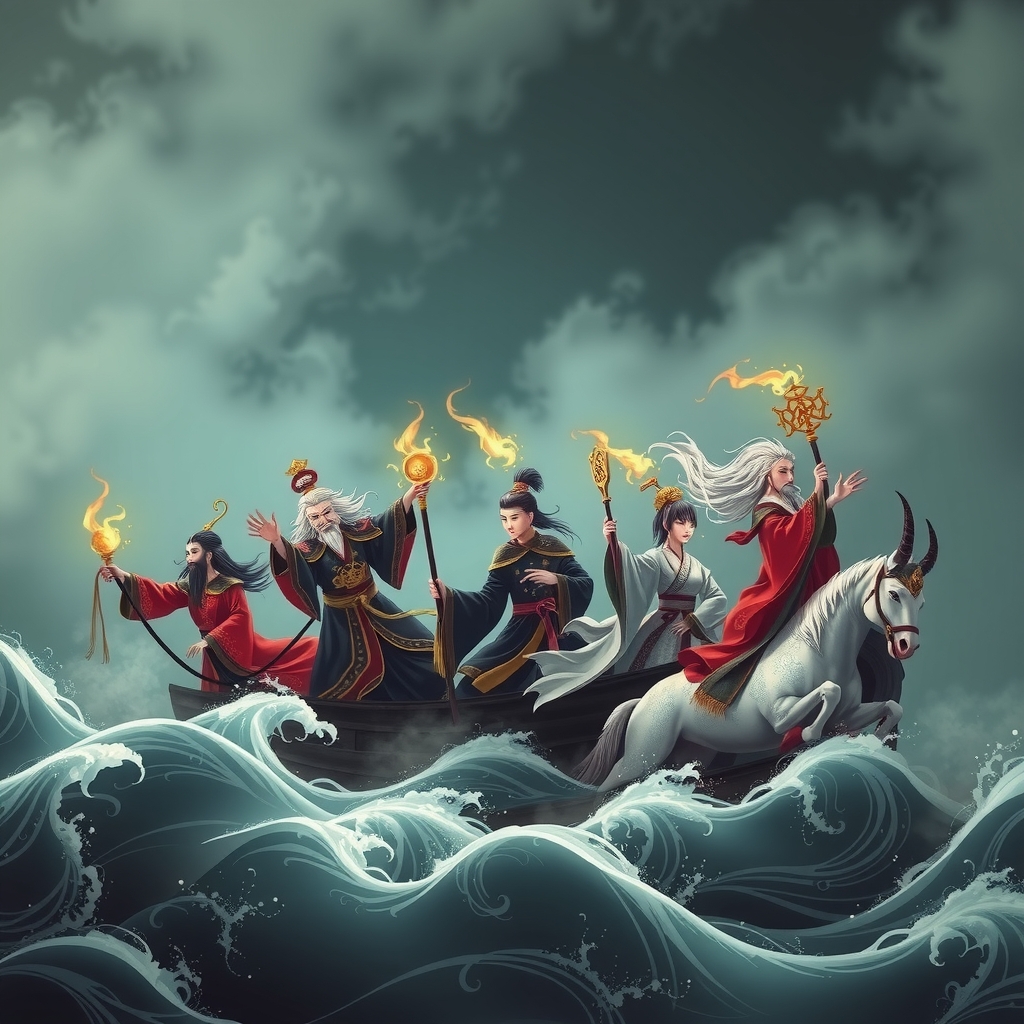
The Eight Immortals frequently travel together, and their journey "crossing the sea" — each using their sacred object to navigate — became a beloved subject in Chinese art, theatre, and literature.
Chinese Dragon Lore
Chinese dragons — Lóng — are radically different from their European counterparts. They are not malevolent fire-breathers but benevolent cosmic beings associated with water, fertility, wisdom, and imperial power. The dragon is yang energy made flesh: majestic, auspicious, and deeply woven into every level of Chinese civilization.
Classical texts describe the Lóng as composite creatures: the head of a camel, the antlers of a stag, the eyes of a hare, the neck of a snake, the belly of a clam, the scales of a fish, the claws of an eagle, the soles of a tiger, and the ears of a cow. They possess a luminous pearl beneath their chin — a symbol of wisdom and the capacity to control rainfall.
🐉 Tianlong — Celestial Dragon
Guards the palaces of the gods and supports the celestial realm from below. These are the most exalted of all dragon types.
🐉 Shenlong — Spirit Dragon
Controls wind and rain. Failure to honour them causes drought; offense causes storms and floods. They must be carefully propitiated.
🐉 Fucanglong — Treasure Dragon
Underground guardians of precious minerals and hidden riches. When they move, volcanoes erupt as they break through the earth's surface.
🐉 Dilong — Earth Dragon
Rules over rivers, streams and the sea floor. Classified as a yin dragon, the earth dragon controls waterways and their flooding cycles.
🐉 Yinglong — Winged Dragon
The oldest of all dragons, possessed of wings — a rare trait. Yinglong aided the Yellow Emperor in battle and was rewarded with residence in the southern sky.
🐉 Jiaolong — Hornless Dragon
Lives in the sea and can provoke floods and storms. The jiaolong is associated with transformation and with sea creatures in general.
The imperial dragon bore five claws — a number restricted to the emperor alone. Nobles wore four-clawed dragon robes; commoners three-clawed dragons. To use the five-clawed dragon without imperial permission was treason punishable by death.
Huangdi — The Yellow Emperor
Among the Five Legendary Emperors of ancient Chinese mythology, none is more revered than Huangdi — the Yellow Emperor — who is considered the common ancestor of all Han Chinese people. Unlike the purely supernatural creator figures, Huangdi straddles the boundary between myth and proto-history: venerated as a divine sovereign who taught humanity the arts of civilization.
The Battle of Zhuolu
Huangdi's defining mythological moment is his great war against Chiyou, the monstrous war god of the south — a bronze-headed, iron-browed demon with the body of a beast who commanded eighty-one brothers, each equally terrible. Chiyou's army wielded supernatural weapons and summoned fogs so thick that Huangdi's forces were utterly lost.
Huangdi responded with divine ingenuity. He commissioned the invention of the south-pointing chariot — a mechanical figure that always pointed south regardless of the vehicle's direction — to navigate the supernatural fog. He summoned the drought goddess Ba to stop Chiyou's rain demons. Finally, at the climactic Battle of Zhuolu, the winged dragon Yinglong (a general in Huangdi's army) turned the tide and Chiyou was captured and executed.
Inventor of Civilization
Chinese tradition credits Huangdi — or his court — with an extraordinary catalogue of inventions that define civilization itself. His court minister Cangjie is credited with inventing Chinese writing after observing the tracks of birds; his consort Leizu with discovering silk after a cocoon fell into her tea; his minister Ling Lun with creating the foundational musical scales. The Yellow Emperor himself is said to have authored the foundational text of Chinese medicine, the Huangdi Neijing (Yellow Emperor's Classic of Medicine), still studied today.
He is also credited with mastering the art of self-cultivation to such a degree that at the end of his long reign, a divine dragon descended from heaven and carried him upward — alive — into immortality. One hundred court ministers and servants are said to have clung to his robes and ascended with him, leaving only dropped sandals and the ceremonial bronze tripods of his earthly court behind.
Writing
Via court minister Cangjie, who studied bird tracks
Silk
Consort Leizu's discovery from a cocoon in her tea
Music
Minister Ling Lun's twelve foundational tones
Compass
The south-pointing chariot invented for battle
Medicine
The Neijing canon of healing still consulted today
Chinese Gods Directory
Fuxi & Nüwa
Creator deities depicted as serpent-bodied humans. Nüwa fashioned humanity from yellow clay and repaired a broken sky using five-coloured stones.
Hou Yi — The Archer
Divine archer who shot down nine of ten suns threatening to scorch the earth. His wife Chang'e stole his immortality elixir and ascended to the moon.
Gonggong — Water God
A destructive water deity who in rage headbutted the cosmic mountain Buzhou, tilting the heavens and causing the great flood that Nüwa had to repair.
Shennong — Divine Farmer
The ox-headed god who tasted every plant to identify its medicinal properties, compiling the first pharmacopoeia and teaching humans to cultivate crops.
Huangdi — Yellow Emperor
The legendary ancestor of the Chinese people and patron of civilization, credited with the invention of writing, mathematics, medicine, and silk cultivation.
Erlang Shen
The third eye divine warrior nephew of the Jade Emperor, who uses his three-pointed spear and divine dog to hunt demons and maintain heavenly order.
Yama — King of Hell
Ruler of the ten courts of Di Yu (the Chinese underworld), who judges the dead and oversees their assignment to punishment, purgatory, or reincarnation.
Xi Wangmu — Queen Mother
The Queen Mother of the West, guardian of the Peach Garden of Immortality, whose peaches ripen every three thousand years and grant eternal life.