Mythality · Sacred Traditions of India
The Eternal Cosmos
of Hindu Mythology
From the primordial syllable Aum to the battlefield revelations of the Gita — explore the boundless universe of Vishnu's avatars, Shiva's cosmic dance, and the heroes who shaped dharma across the ages.
Begin the JourneyThe Divine Trinity
The Trimurti — Brahma, Vishnu & Shiva
At the heart of Hindu cosmology stands the Trimurti — three aspects of the supreme Brahman governing creation, preservation, and dissolution in an eternal cycle measured in cosmic ages.
Brahma — The Creator
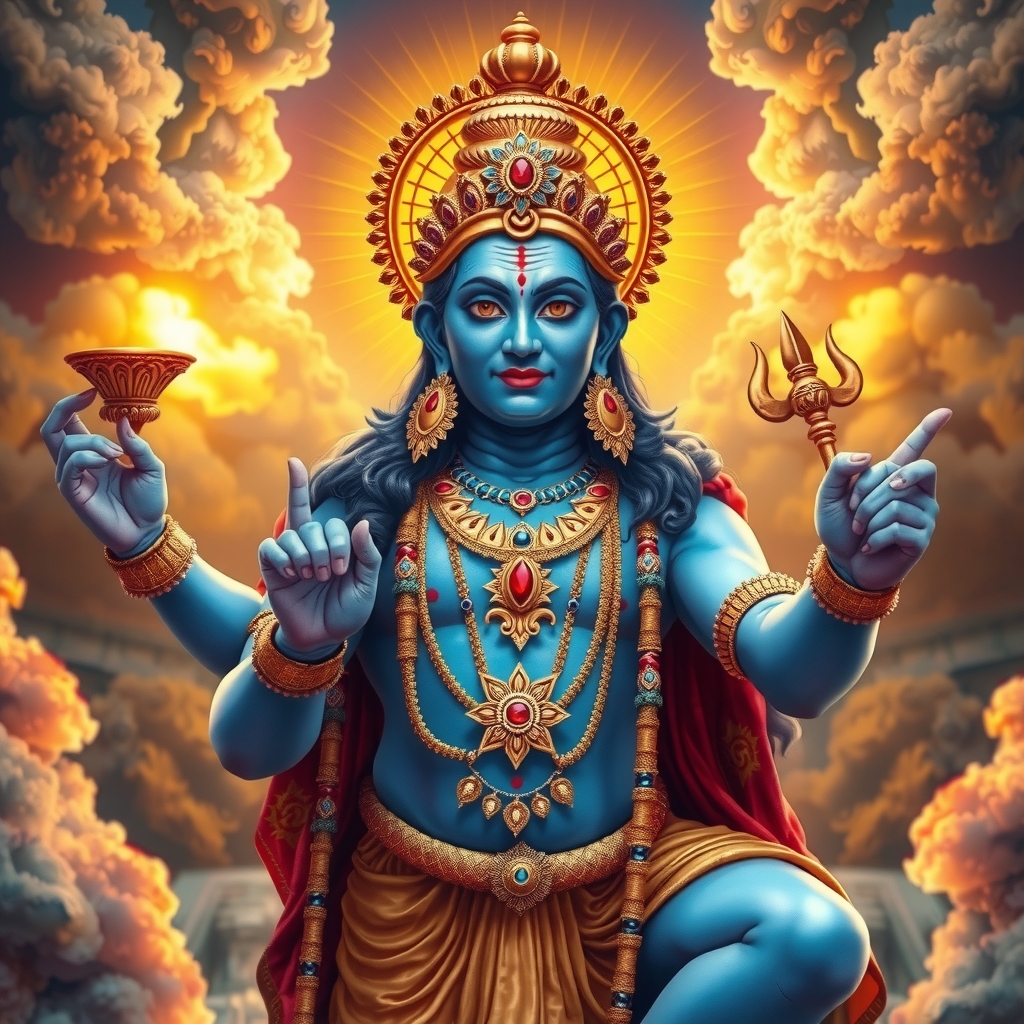
Born from the golden cosmic egg Hiranyagarbha, Brahma fashioned the material universe from his own body. Four-headed to observe all directions simultaneously, he dictated the Vedas and wove the fabric of all living beings. His creative era spans a full Brahma-day of 4.32 billion mortal years, after which the universe dissolves and is born again.
Vishnu — The Preserver
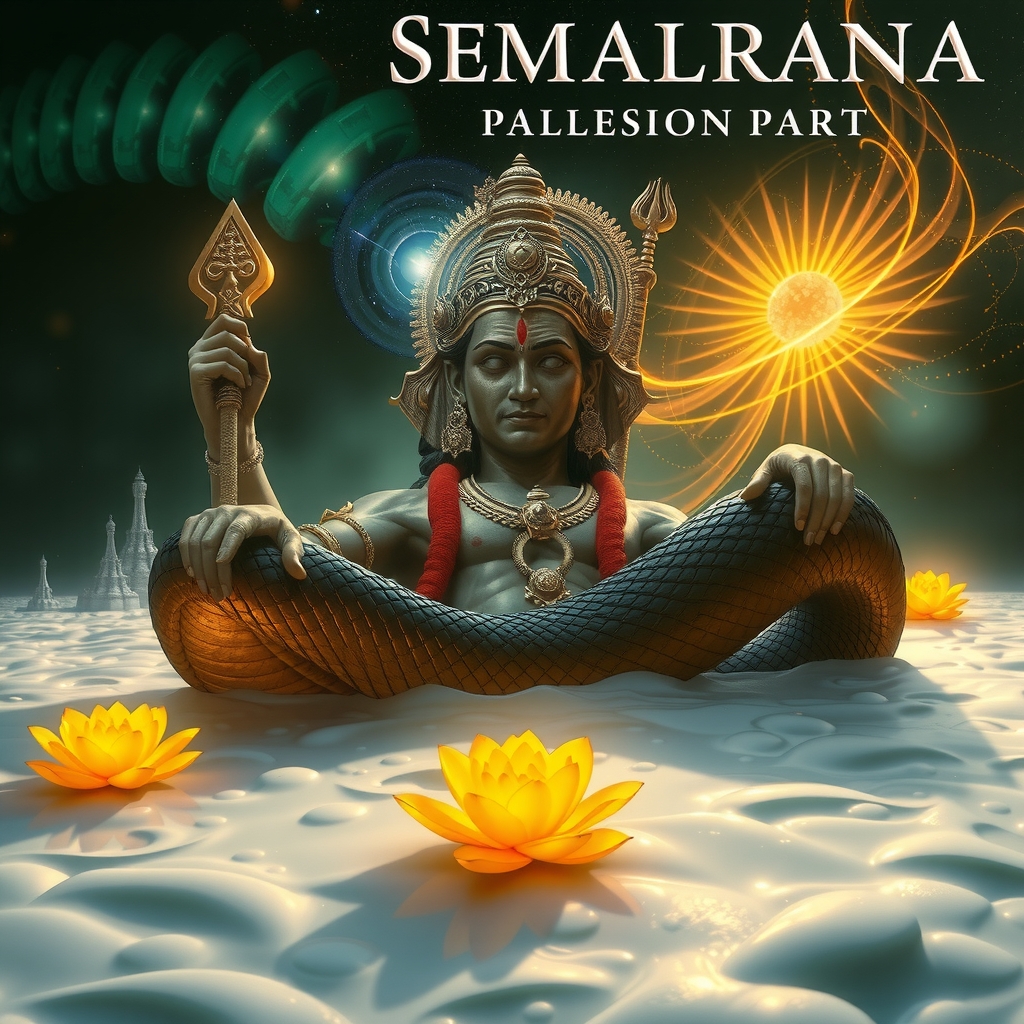
Resting upon the cosmic serpent Shesha on the primordial ocean, Vishnu is the sustainer of dharma. When cosmic order falters, he descends as one of his ten avatars — from Matsya the fish to Kalki yet to come — to restore righteousness. His consort Lakshmi embodies divine fortune; together they represent the benevolent face of the eternal.
Shiva — The Destroyer
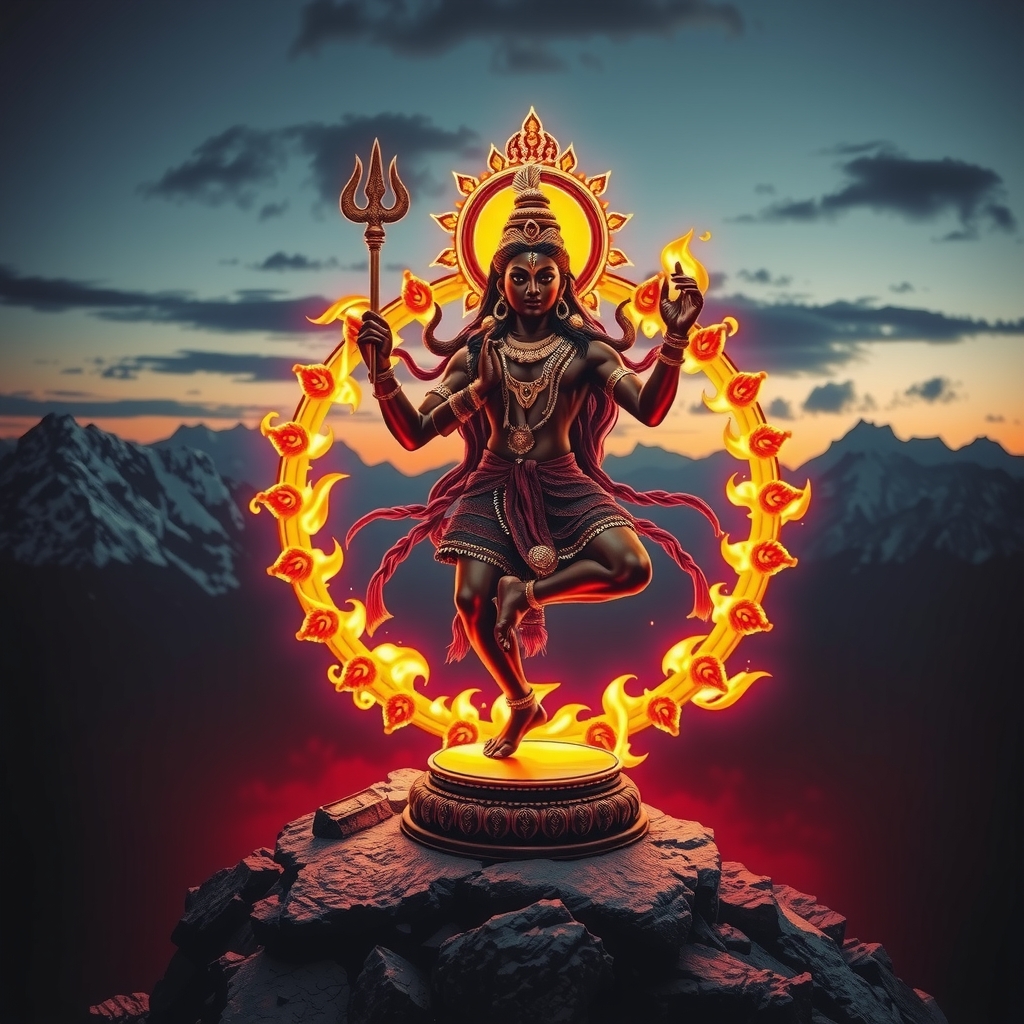
Lord of the cosmic dance Tandava, Shiva embodies the paradox of asceticism and ferocity. Dwelling on Mount Kailash with the Ganges flowing from his matted locks, he is simultaneously destroyer and transformer. His Nataraja form — dancing within a ring of fire — encapsulates the eternal rhythm of destruction from which new creation springs.
The Great Epic
The Ramayana — Rama's Epic Journey
Composed by the sage Valmiki in 24,000 verses, the Ramayana is at once a royal adventure, a meditation on ideal virtue, and the story of a divine avatar walking among mortals. It is the story of how dharma — righteous duty — can survive exile, war, and separation.
I. The Birth of Rama
King Dasharatha of Ayodhya performed the sacred Putrakameshti yajna to beget heirs. The gods answered with four sons — Rama, the eldest and avatar of Vishnu, born radiant as the midday sun. From boyhood, Rama displayed superhuman virtue: compassionate, skilled in arms, devoted to truth above all comfort.
II. The Swayamvara & Sita
King Janaka announced that whoever could string the divine bow of Shiva would wed his daughter Sita — herself a manifestation of Lakshmi. Princes from across the world failed. The young Rama not only strung the bow but broke it in two with a single pull, winning Sita and fulfilling divine destiny.
III. Exile Into the Forest
On the eve of Rama's coronation, Queen Kaikeyi demanded two boons from Dasharatha — her son Bharata crowned king, and Rama exiled for fourteen years. Bound by his oath, Dasharatha wept but relented. Rama accepted his exile without bitterness; Sita and his devoted brother Lakshmana chose to accompany him into the wilderness.
IV. The Abduction of Sita
The demon king Ravana of Lanka, lusting after Sita, devised a scheme using a golden deer to lure Rama and Lakshmana away. In their absence, Ravana appeared as a mendicant and abducted Sita, carrying her across the sea to his island fortress. The vulture-king Jatayu fought bravely but fell mortally wounded.
V. The Vanara Alliance
Grief-stricken, Rama encountered the monkey-general Hanuman, devoted servant of the monkey-king Sugriva. Rama helped Sugriva reclaim his throne; in return, Sugriva's vast vanara army pledged to help find Sita. Hanuman, son of the wind-god Vayu, leaped across the ocean to Lanka and discovered Sita imprisoned in the Ashoka grove.
VI. The War at Lanka
The vanara army built a miraculous floating bridge of stones across the sea — each stone inscribed with Rama's name stayed buoyant. After a siege of staggering battles, Rama slew Ravana's champions one by one. When Lakshmana fell to a brahmastra, Hanuman flew to the Himalayas and returned with the entire mountain bearing life-restoring herbs.
VII. The Slaying of Ravana
Ravana, ten-headed and seemingly immortal, was finally overcome when Rama fired the Brahmastra — the celestial weapon forged by Brahma himself. The arrow struck Ravana's navel where his immortality resided, and the demon king fell at last. Even in victory, Rama mourned for Ravana's greatness corrupted by pride and desire.
VIII. The Return to Ayodhya
Rama, Sita, and Lakshmana flew home aboard Ravana's aerial chariot Pushpaka on the night of Kartik Amavasya. The citizens of Ayodhya lit rows of lamps — diyas — to guide their beloved prince home through the darkness. This night became the festival of Diwali, the eternal victory of light over darkness, celebrated across the world to this day.
The Longer Epic
Krishna & the Mahabharata
"The battlefield of Kurukshetra — where Arjuna received the eternal teaching of the Gita"
The War of Dharma
The Mahabharata, 10 times the length of the Iliad and Odyssey combined, chronicles the catastrophic war between the Pandava brothers and their cousins the Kauravas for control of Hastinapura. At its heart is a question as old as civilization: what does righteousness demand when family stands against duty?
Krishna — the eighth avatar of Vishnu — served as charioteer to the Pandava archer Arjuna. When Arjuna faltered before battle, unable to raise arms against his kinsmen, Krishna delivered the Bhagavad Gita: eighteen chapters of philosophical revelation that form one of humanity's most profound spiritual texts.
The eighteen-day battle of Kurukshetra saw the death of heroes on both sides — Bhishma the invincible, Drona the master teacher, Karna the tragic rival. After the Pandavas' final victory, five brothers and their queen Draupadi undertook the great journey toward heaven, each falling on the path — all but Yudhishthira, whose virtue was absolute.
"You have a right to perform your prescribed duties, but you are not entitled to the fruits of your actions. Never consider yourself the cause of results of your activities, and never be attached to not doing your duty."— Bhagavad Gita, Chapter 2, Verse 47
Dashavatara
The Ten Avatars of Vishnu
Across the four Yugas, Vishnu descends to Earth in mortal form to restore cosmic order. His ten principal avatars trace the evolution of life from ocean creatures to the divine human — and finally to the apocalyptic Kalki yet to come.
Matsya
The great fish who saved Manu and the Vedas from the primordial flood.
Kurma
The cosmic tortoise who bore Mount Mandara on his back during the churning of the ocean.
Varaha
The boar who dove into the cosmic ocean and raised the earth on his tusks.
Narasimha
The man-lion who emerged from a pillar to slay the demon Hiranyakashipu.
Vamana
The dwarf brahmin who reclaimed the three worlds from King Bali in three steps.
Parashurama
The warrior-sage who cleared the earth of corrupt kshatriyas twenty-one times.
Rama
The ideal king and hero of the Ramayana who defeated the demon Ravana.
Krishna
The divine cowherd, teacher of the Gita, and architect of the Mahabharata's dharmic resolution.
Buddha
The enlightened teacher who guided humanity toward compassion and the end of suffering.
Kalki
The white-horsed warrior yet to come, who will end the Kali Yuga and restore the age of truth.
Shakti — The Divine Feminine
Devi — The Great Goddess & Her Forms
Shakti — the primordial energy — cannot be separated from the divine. Without her, even Shiva is inert. She manifests across the cosmos in forms nurturing and ferocious, as mother and as warrior, as cosmic abundance and as the destroyer of ego.
Lakshmi
Born from the churning of the cosmic ocean, Lakshmi is the goddess of wealth, fortune, and beauty. Consort of Vishnu, she accompanies him in each avatar — as Sita to Rama, as Rukmini to Krishna. Her lotus symbolizes prosperity untainted by earthly mud.
Saraswati
Consort of Brahma and goddess of knowledge, music, and learning. Dressed in pure white, she carries the veena, Vedas, and a lotus. Saraswati embodies the creative power that makes knowledge beautiful — the river of wisdom that flows through all human arts and sciences.
Durga
When the gods could not defeat the demon Mahishasura, they combined their divine energies into the warrior goddess Durga. Riding a lion, eighteen-armed and radiant, she fought for nine days before slaying the demon on the tenth — celebrated as Navaratri, the festival of nine nights of the goddess.
Kali
Emerging from Durga's brow in the heat of battle, Kali is the dark and terrible aspect of the goddess. Her black skin represents the void beyond time; her skull necklace symbolizes transcendence of death. Yet beneath her fearsome form lies the most unconditional love — she who destroys only what obscures truth.
Parvati
Daughter of the mountain king Himalaya, Parvati undertook tremendous ascetic practice to win Shiva as her husband. She is the perfect complement to Shiva's solitary power — together they represent the union of consciousness and energy, stillness and movement, upon which all creation depends.
Radha
Though not always classified among the major deities, Radha's love for Krishna is regarded in Vaishnavite tradition as the purest model of devotion — bhakti itself made flesh. The Radha-Krishna dynamic inspired centuries of devotional poetry and represents the soul's yearning for union with the divine.
Reference
Hindu Gods Directory
A scholarly reference to the principal deities, their domains, symbols, and consorts.
| Deity | Domain | Symbols | Vehicle | Consort |
|---|---|---|---|---|
| Brahma | Creation, knowledge | Four heads, lotus, Vedas, kamandalu | Hamsa (swan/goose) | Saraswati |
| Vishnu | Preservation, dharma | Conch, discus (Sudarshana), mace, lotus | Garuda (eagle) | Lakshmi |
| Shiva | Destruction, transformation | Trishula, damaru drum, crescent moon | Nandi (bull) | Parvati |
| Indra | Thunder, rain, heavens | Vajra (thunderbolt), elephant Airavata | Airavata | Shachi |
| Agni | Fire, purification, sacrifice | Flame, seven hands, ram | Ram | Svaha |
| Surya | The sun, light, cosmic order | Solar disc, lotus, chariot of seven horses | Seven-horse chariot | Sanjna |
| Ganesha | Beginnings, wisdom, removal of obstacles | Elephant head, modaka sweet, broken tusk | Mushaka (mouse) | Riddhi & Siddhi |
| Kartikeya | War, valor, youth | Spear (vel), peacock, rooster banner | Peacock | Devasena |
| Yama | Death, justice, dharma | Staff, noose, buffalo | Buffalo | Dhumorna |
| Vayu | Wind, breath, prana | White banner, deer | Deer / gazelle | — |
| Varuna | Cosmic waters, truth, law | Noose (pasha), lotus | Makara (sea creature) | Varuni |
| Hanuman | Devotion, strength, selfless service | Mace, mountain, Rama's image in heart | None (flies unaided) | Suvarchala |