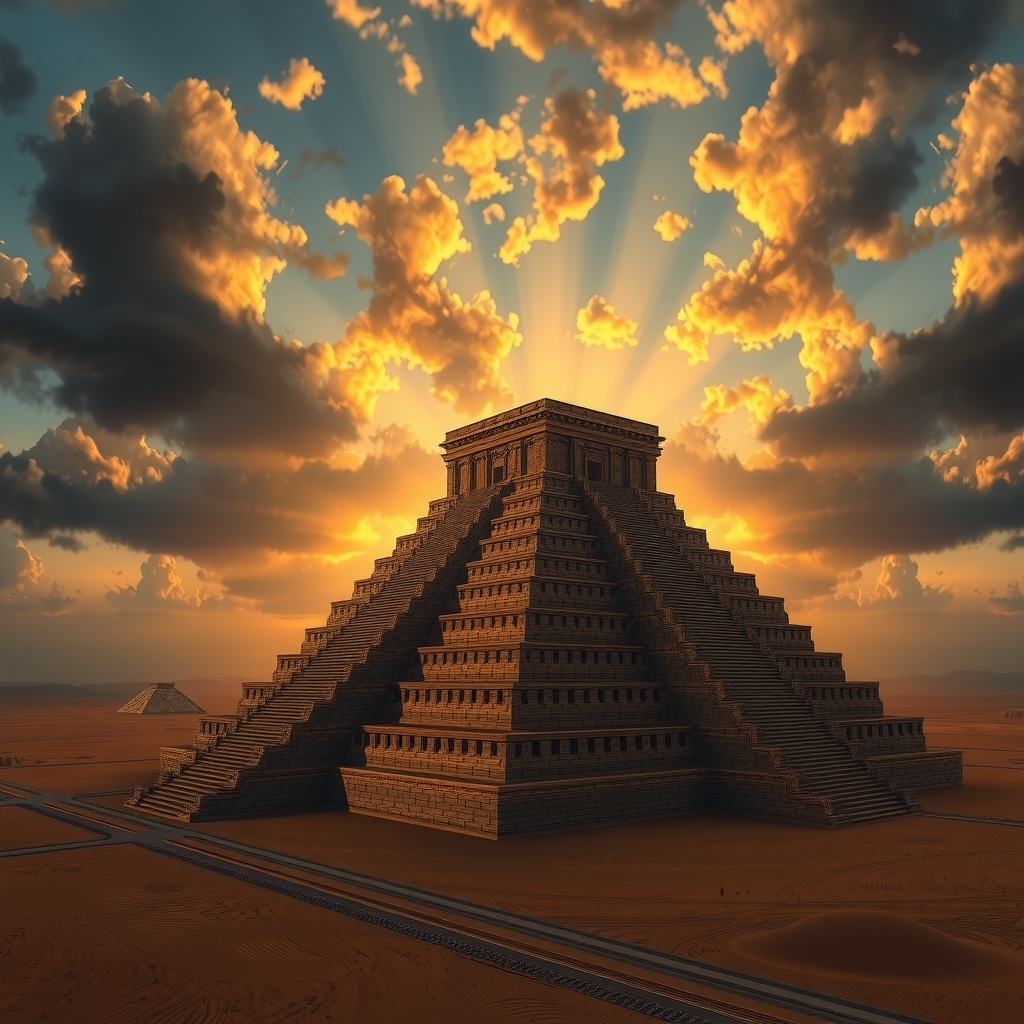
Cradle of Myth
Long before Homer sang of Troy, the scribes of Sumer pressed gods and monsters into wet clay. Here lie humanity's oldest stories — the first heroes, the first gods, the first flood.
Enter the First AgeThe Enuma Elish — Creation of the World
Composed in Akkadian Babylonian cuneiform around 1100 BCE — though rooted in far older Sumerian tradition — the Enuma Elish is one of the most significant creation narratives in human history. Its name means "When on High," the opening words of the text, and it describes the birth of the cosmos from primordial waters, the war of the gods, and the fashioning of humanity from divine blood.
The myth begins before the world had a name. Two beings existed in the undifferentiated deep: Apsu, the freshwater abyss below, and Tiamat, the saltwater ocean above. From their mingling came the younger gods — noisy, chaotic, and deeply irritating to the primordial pair.
Tablet I — The Primordial Waters
Apsu and Tiamat exist in primal stillness. The younger gods, born from their union, disturb the peace with their clamour. Apsu plots to destroy them. The god Ea discovers the plan and slays Apsu first, establishing his throne upon the slain god's body.
Tablets II–IV — The War of Tiamat
Tiamat, enraged at Apsu's death, raises an army of monsters and elevates Kingu as her champion, giving him the Tablet of Destinies. Marduk, son of Ea, challenges Tiamat alone. He traps her in his net, pierces her with his spear, then splits her body in two — one half becomes the sky, the other the earth.
Tablets V–VII — The Creation of Humanity
From Tiamat's blood and bones, Marduk fashions the cosmos. He assigns the great gods their stations and creates humanity from the blood of Kingu — slain for his role in the rebellion — so that mortals might serve the gods and free them from menial labor. Babylon itself is built as the gods' eternal resting place.
The Enuma Elish was recited in full on the fourth day of Akitu, the Babylonian New Year festival, reaffirming Marduk's sovereignty and the cosmic order. It establishes a foundational theme that echoes through world mythology: creation born not from harmony, but from conflict and sacrifice.
Gilgamesh — King, Wanderer, Mortal
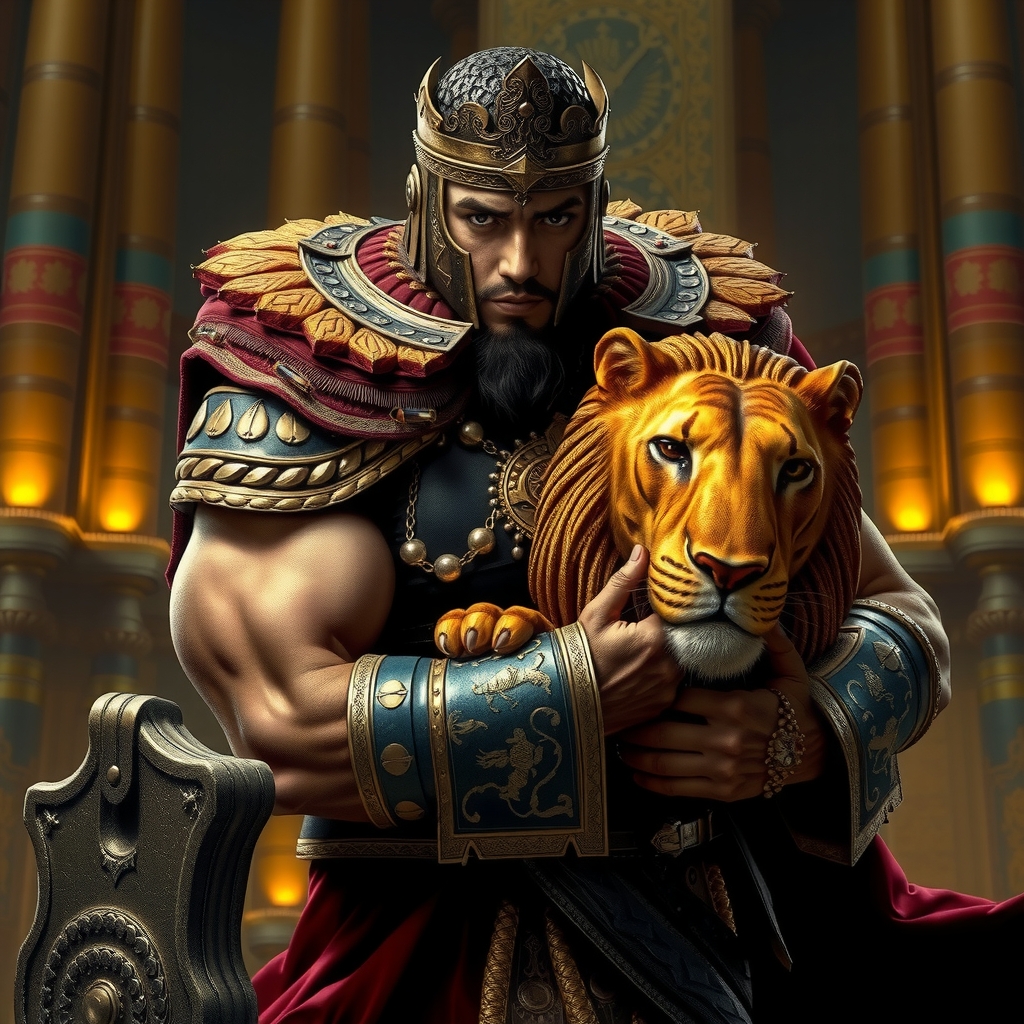
The Epic of Gilgamesh is the oldest substantial work of literature on earth. Assembled from Sumerian poems into an Akkadian masterwork around 1200 BCE (the Standard Babylonian version, copied by the scribe Sîn-lēqi-unninni), it asks questions that no subsequent civilization has stopped asking: What does it mean to be human? Can death be cheated? Is fame enough?
Gilgamesh ruled the city of Uruk — a real historical city in what is now southern Iraq — as a semi-divine king, two-thirds god and one-third mortal. He was magnificent, terrifying, and oppressive. The gods created Enkidu, a wild man of the steppe, to be his equal and companion.
The Tyrant of Uruk
Gilgamesh is mighty beyond all kings, but his strength becomes cruelty. He claims the right of first night with brides and exhausts his warriors. The people cry out to the gods for relief.
Enkidu the Wild
The goddess Aruru shapes Enkidu from clay — hairy, powerful, living among gazelles. A temple priestess, Shamhat, civilizes him over seven days. He comes to Uruk; he and Gilgamesh wrestle, then embrace as brothers.
The Forest of Cedar
Together they journey to the Cedar Forest, domain of the monstrous guardian Humbaba. Despite Enkidu's misgivings, they confront Humbaba. Gilgamesh hesitates; Enkidu urges the kill. They slay Humbaba and return in glory.
Ishtar's Wrath
The goddess Ishtar proposes marriage to Gilgamesh. He rejects her savagely, listing her discarded lovers. Furious, she sends the Bull of Heaven to ravage Uruk. Enkidu and Gilgamesh slay it. Enkidu hurls its haunch at Ishtar in contempt.
The Death of Enkidu
The gods decree that Enkidu must die as punishment for the deaths of Humbaba and the Bull. He sickens over twelve days. Gilgamesh watches his companion die and is shattered — perhaps the first portrait of grief in world literature.
The Search for Immortality
Terrified of death, Gilgamesh sets out to find Utnapishtim — the only mortal granted eternal life. He crosses the Waters of Death and learns of the Flood. He obtains a plant of immortality from the ocean floor. A serpent steals it as he sleeps.
The Return
Gilgamesh returns to Uruk, his city. The tavern keeper Siduri had counselled him: "When the gods created mankind, they allotted death to mankind." He reads the walls of Uruk — his monument — and perhaps understands.
Why It Endures
In Gilgamesh we see friendship, mortality, hubris, grief, and the search for meaning. These themes make the epic feel startlingly modern — a reminder that the human condition has not changed in four thousand years.
Ishtar's Descent into the Underworld
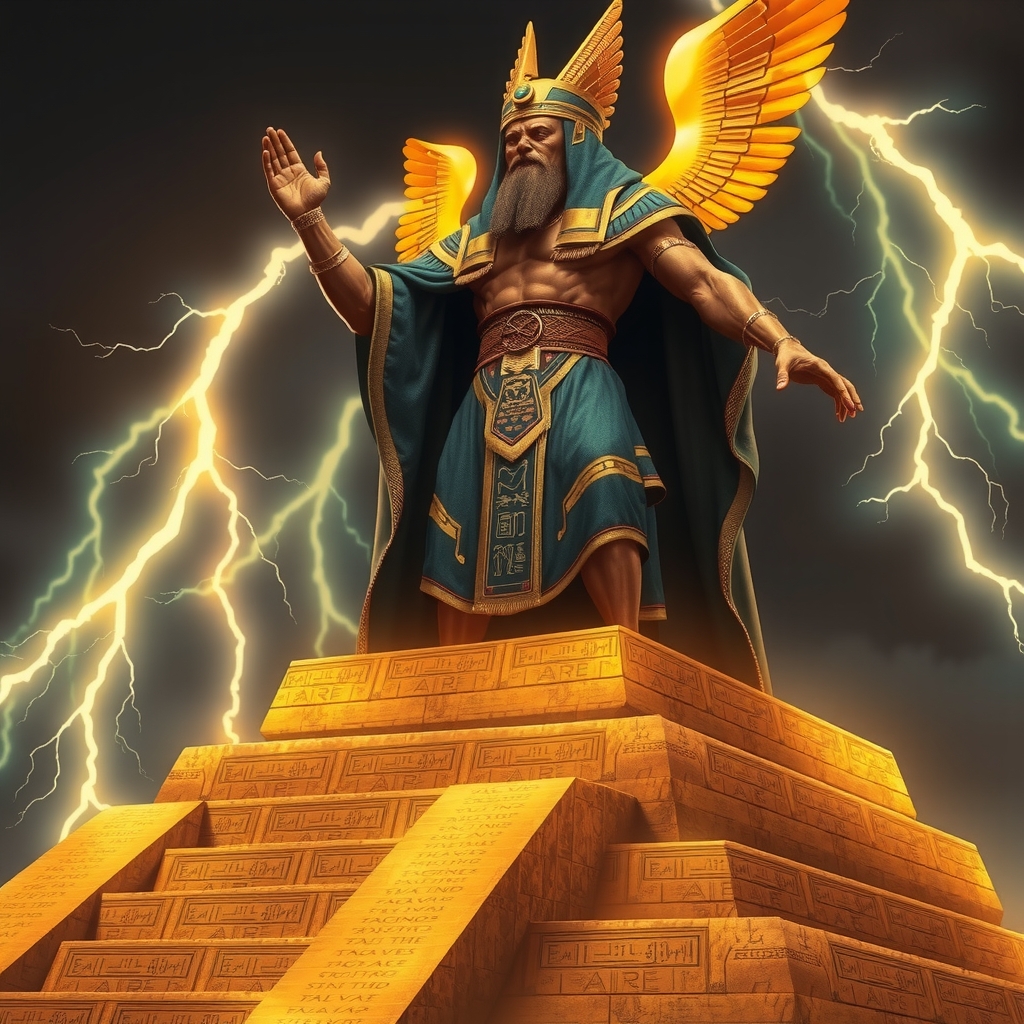
One of the most haunting texts of the ancient world, the Descent of Ishtar follows the great goddess of love and war into Irkalla — the underworld ruled by her sister Ereshkigal. The reasons for her descent vary: some texts suggest she sought power over death itself; others hint at a mourning for her consort Tammuz. Whatever her motive, the journey nearly destroys the world.
The underworld has seven gates. At each gate, Ishtar must surrender a garment or ornament — stripped of her divine power piece by piece. The allegory is rich: the goddess of fertility, love, and war rendered naked and powerless before death.
The Great Crown — At the first gate, Ishtar surrenders her crown. Divine authority begins to slip away.
Pendants of her ears — Perception and listening stripped. She enters deeper darkness.
Necklace of lapis lazuli — Her beauty and station begin to fade.
Ornaments of her breast — Love itself is surrendered at the midpoint of descent.
Girdle of her hips — Desire and fertility abandoned. The earth above grows barren.
Clasps of her hands and feet — Power of action surrendered. She can neither embrace nor flee.
The garment covering nakedness — She arrives before Ereshkigal utterly stripped of divinity, mortal in every way.
Ereshkigal afflicts Ishtar with sixty diseases and hangs her corpse on a hook. With the goddess of fertility absent from the world, all reproduction ceases — neither human nor animal can couple; the world begins to die. The gods, panicking, send Asushunamir, an androgynous being, to ransom her. Ishtar is revived and ascends, reclaiming each adornment at each gate. But a price must be paid: someone must descend in her place. She sends Tammuz, her shepherd-consort — perhaps the first mythological scapegoat.
The Great Flood — Before Noah
Nested within Tablet XI of the Epic of Gilgamesh is one of history's most consequential passages: the Flood Narrative of Utnapishtim. Predating the biblical Genesis account by at least a thousand years, it presents a strikingly parallel story — yet one that illuminates crucial differences in how Mesopotamian and later Abrahamic cultures understood the divine and human relationship.
🌊 Utnapishtim (Sumerian/Akkadian)
The gods decide to destroy humanity for being too noisy. Ea secretly warns Utnapishtim through the wall of his reed hut. He builds a great vessel, loads his family, craftsmen, and "the seed of all living things." The flood lasts six days and nights. A dove, swallow, and raven are released to test for land. The raven does not return. Utnapishtim makes sacrifice; the gods smell it and gather. He is granted immortality for preserving life.
📖 Noah (Biblical / Genesis)
God is displeased by human wickedness and decides to destroy all life. He specifically selects Noah — a righteous man — and warns him directly. Noah builds an ark with precise divine instructions. Animals enter in pairs. Rain falls for forty days and nights. A dove is sent out three times; on the third release it does not return. Noah makes sacrifice; God smells it and vows never again to destroy all life. Noah and his family repopulate the earth.
Scholars debate whether the two accounts share a common source, whether one influenced the other, or whether both preserve memory of actual catastrophic flooding in the ancient Near East — perhaps the breaching of the Black Sea basin around 5600 BCE. What is certain is that the Mesopotamian version is older, more morally ambiguous (the gods act from irritation, not righteousness), and deeply embedded in a culture that saw the gods as dangerously capricious.
Earlier Still: The Sumerian Flood Narrative (the Eridu Genesis, c.1600 BCE in surviving form but likely older) features Ziusudra as the flood hero — the Sumerian predecessor to Utnapishtim. These stacked traditions suggest the flood myth was among the most ancient and persistent stories in human memory.
The Anunnaki — Gods of Heaven and Earth
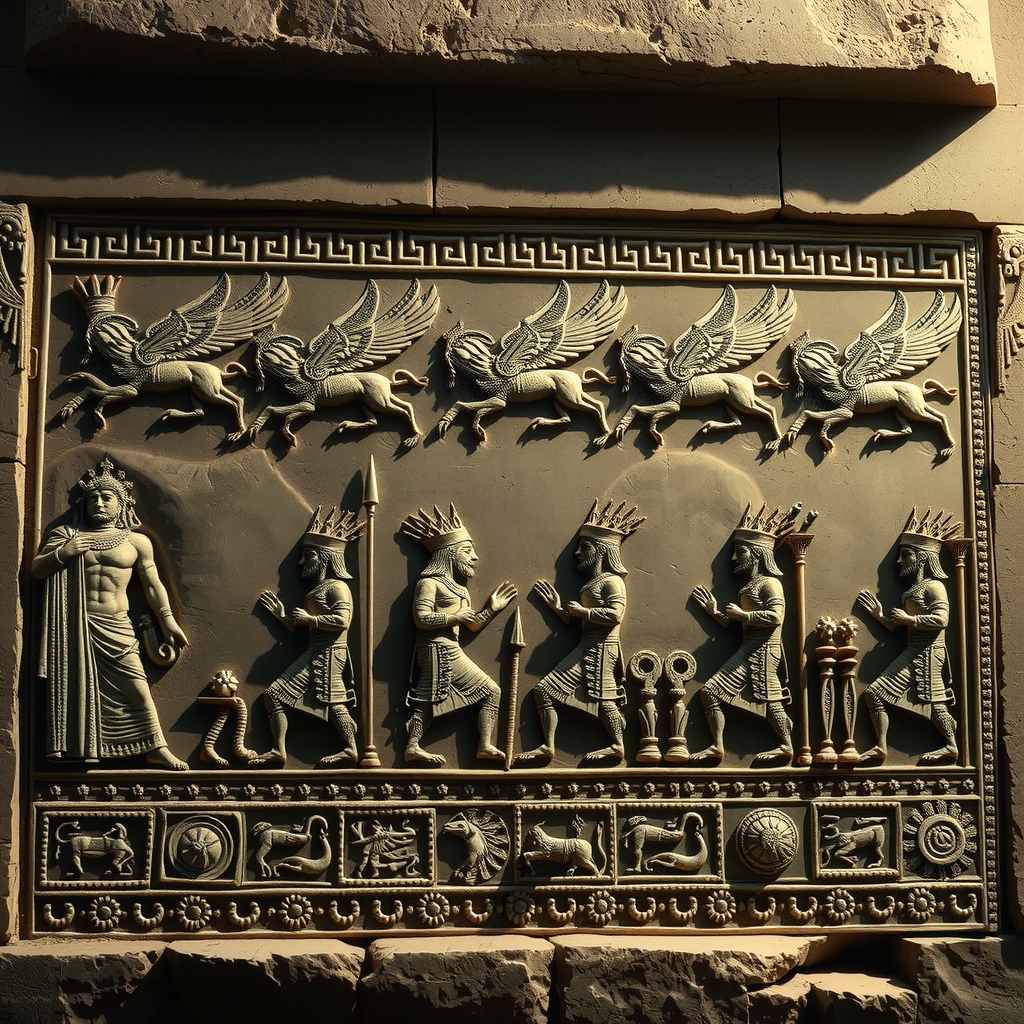
The Anunnaki — "those of royal blood" or "those who came from heaven to earth" — were the great gods of the Sumerian and Babylonian pantheon. They formed a divine assembly or council that decreed fates, governed cosmic forces, and intervened in mortal affairs. The Anunnaki were not distant abstractions; they were believed to literally dwell in their temple-ziggurats, fed and clothed daily by priests.
An (Anu)
King of the heavens, father of the gods. His will was absolute but remote — he rarely intervened directly in earthly matters.
Enlil
Lord of air and storms, god of the earth and wind. Second in power to Anu and often the gods' decision-maker. He decreed the flood.
Enki (Ea)
God of wisdom, fresh water, and magic. A trickster-benefactor who frequently saved humanity from the other gods' wrathful decrees.
Shamash (Utu)
The sun god, god of justice and truth. He illuminated the world by day and judged the dead at night. Patron of Hammurabi's law code.
Nanna (Sin)
Moon god of Ur, father of Shamash and Ishtar. Associated with wisdom, cattle, and the passage of time through lunar cycles.
Ishtar (Inanna)
Goddess of love, war, and the morning star. Passionate, dangerous, and enormously powerful. The most widely worshipped deity of the region.
Marduk
Patron god of Babylon, slayer of Tiamat, king of the gods in the Babylonian tradition. His rise to supremacy mirrors Babylon's political ascendancy.
Ereshkigal
Queen of the Great Below, ruler of the underworld. Sister of Ishtar, she governs the dead with implacable authority.
Ninhursag
The great mother goddess, "Lady of the Sacred Mountain." She fashioned humanity alongside Enki and presided over birth and fertility.
Mesopotamian Gods Directory
A scholarly reference to the primary deities of the Sumerian and Babylonian pantheons, with their domains, sacred cities, and symbols.
| Deity | Tradition | Domain | Sacred City | Symbol |
|---|---|---|---|---|
| Anu | Sumerian/Akkadian | Sky, kingship | Uruk | Horned crown |
| Enlil | Sumerian/Akkadian | Air, storm, earth | Nippur | Crown, flood |
| Enki / Ea | Sumerian/Akkadian | Water, wisdom, magic | Eridu | Goatfish |
| Inanna / Ishtar | Sumerian/Akkadian | Love, war, Venus | Uruk / Akkad | Eight-pointed star |
| Nanna / Sin | Sumerian/Akkadian | Moon, wisdom | Ur | Crescent moon |
| Utu / Shamash | Sumerian/Akkadian | Sun, justice | Sippar / Larsa | Solar disc with rays |
| Marduk | Babylonian | Creation, kingship | Babylon | Mushhushshu dragon |
| Nergal | Akkadian | Death, plague, war | Cutha | Lion-headed mace |
| Ereshkigal | Sumerian/Akkadian | Underworld | Irkalla | Lion-headed staff |
| Ninhursag | Sumerian | Motherhood, birth | Adab / Kesh | Omega symbol |
| Nabu | Babylonian | Writing, wisdom | Borsippa | Stylus on tablet |
| Tiamat | Babylonian | Primordial sea, chaos | — | Dragon / serpent |
| Dumuzi / Tammuz | Sumerian/Akkadian | Vegetation, shepherds | Bad-tibira | Crook and staff |
| Ninurta | Sumerian/Akkadian | War, agriculture | Girsu / Nippur | Double lion mace |